
One annual bill, and what you buy carries a transaction ceiling, not a per-trade fee.
CoinTracker is a US-focused cryptocurrency tax and portfolio tracking platform. Pricing is unusual for the category: four published plans, all billed annually, and the active year covers both the current tax year and every past year’s forms.
That last point matters. Once you pay for Prime, historical tax forms come with it at no extra cost. The other distinguishing feature is per-year flat pricing — you are billed for the tax year, not per transaction, though every paid tier still caps how many transactions it will process.
CoinTracker quotes in local currency across 40+ countries, with local cost-basis rules and country-specific forms rather than a single US template.
What CoinTracker actually sells
CoinTracker is a tax-and-portfolio platform for crypto holders and active traders. The product surface splits into four pieces.
Portfolio tracking aggregates balances across exchanges, wallets, and on-chain addresses into a single view. Cost basis calculation rebuilds the per-lot acquisition cost using the method you choose — FIFO, LIFO, HIFO, or specific ID. Tax form generation produces IRS Form 8949, Schedule D, and country-specific equivalents.
Tax-loss harvesting, from the Prime tier up, surfaces losses worth claiming before the year closes (cointracker.io/pricing, captured recently).
The transaction-handling model is the distinguishing design choice. Each paid tier caps the number of transactions the platform will process for tax purposes.
The published caps are Base up to 100 transactions a year, Prime up to 1,000, and Ultra up to 10,000. Above your cap you move to the matching “plus” tier: Base+ at $99 covers 250 transactions, Prime+ at $299 covers 2,500, and Ultra+ at $1,999 covers 50,000.
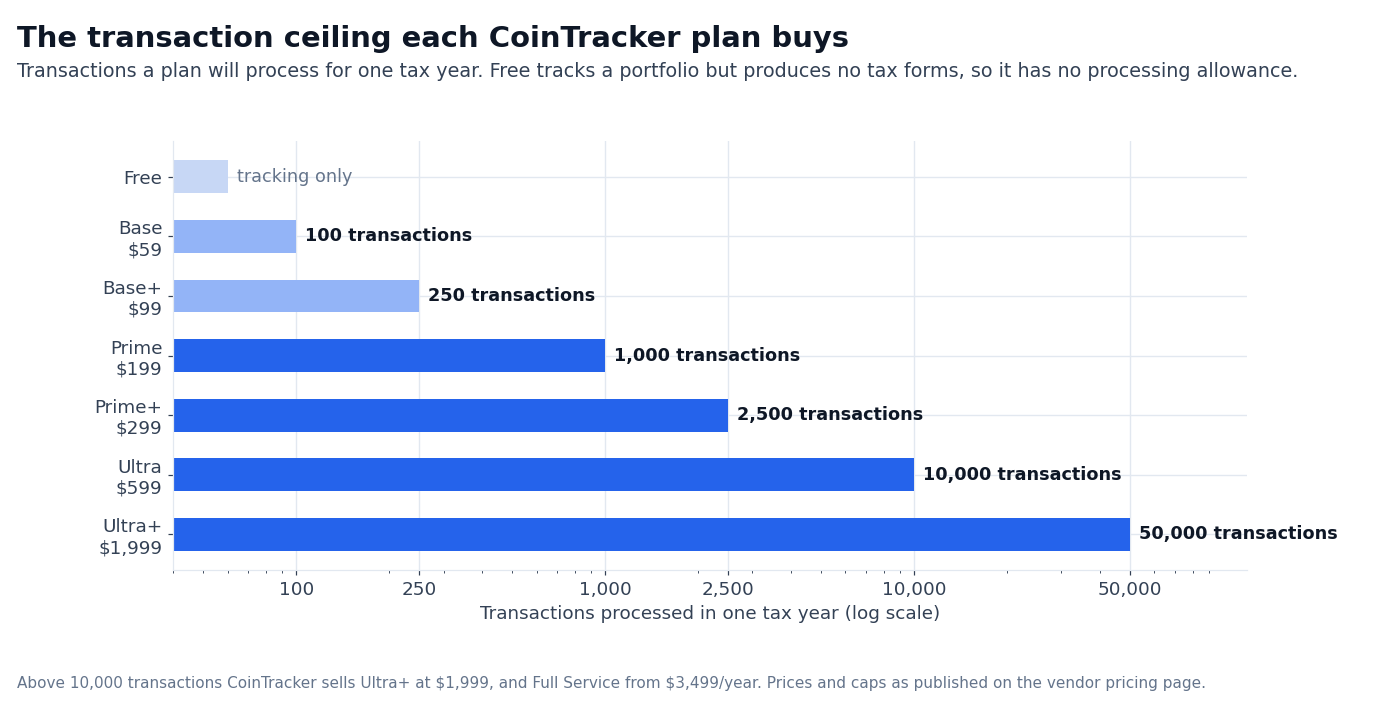
Beyond that the vendor sells Full Service from $3,499/year, where its team prepares the return.
The free tier exists as a portfolio tracker — useful for crypto holders who do not need tax forms but want a single dashboard for balances. It includes a tax summary but no downloadable forms.
How the four pricing tiers break down
| Plan | Price | Transactions | Best for |
|---|---|---|---|
| Free | $0 | Tracking only | Portfolio view, tax summary, no forms |
| Base | $59/year | Up to 100 | Buy-and-hold on one exchange, basic forms |
| Prime | $199/year | Up to 1,000 | Active trading across exchanges, loss harvesting surfaced |
| Ultra | $599/year | Up to 10,000 | DeFi, bridges, LP positions, staking, complex wallets |

Above Ultra, the plus tiers and Full Service take over: Base+ $99 for 250 transactions, Prime+ $299 for 2,500, Ultra+ $1,999 for 50,000, and Full Service from $3,499/year.
The plan ladder maps cleanly to user type. A buy-and-holder on Coinbase with one wallet and a few swaps a year fits Base. An active trader running multiple exchanges with hundreds of trades fits Prime. A DeFi user with LP positions, bridges, staking rewards, and NFT flips fits Ultra.
The transaction cap is the most important number to check before buying. If you have 500 trades on Coinbase and 200 on Kraken plus some wallet activity, you are at 700-800 — Prime’s 1,000 cap is comfortable.
If you are actively providing liquidity on Uniswap and bridging across chains, you can hit 5,000+ transactions easily. Ultra’s 10,000 ceiling still covers that year, and the jump to Ultra+ only bites past it (cointracker.io, captured recently).
What the per-year pricing actually delivers
Two specific benefits are worth understanding.
Active year plus past years. When you buy a Prime plan for tax year 2026, you get the Prime features for 2026 and all of your prior years’ tax forms included. If you have held crypto since 2020 and this is your first year using a tax tool, that past-years coverage is part of what you are paying for.
Flat pricing instead of per-transaction billing. CoinTracker does not charge per trade — the cap is the limit, and the price is the same whether you file 100 transactions or 10,000. The trade-off is the ceiling itself: at 10,000 transactions Ultra ends and Ultra+ begins at $1,999/year.
Koinly, ZenLedger, and TokenTax run the same way — annual tiers with a transaction allowance — so the comparison is really about where each ladder steps and how much headroom each plan gives you.
What each plan supports under the hood
Base ($59/yr) covers the core forms — Form 8949 and Schedule D for US filers, plus local equivalents. Cost basis is rebuilt for every lot you hold, and exchange history is matched against on-chain records.
Prime ($199/yr) adds the loss-harvesting engine. The platform reconciles every fill across exchanges, not just lot by lot, and surfaces losses worth claiming before the year closes.
Ultra ($599/yr) adds full DeFi and on-chain coverage. LP positions, staking rewards, bridge transactions, NFT mints and sales, lending interest, and airdrops are all supported, and cost basis is traced across transfers, wraps, and bridges.
The free tier ($0) is for users who want a portfolio view without tax forms. Tax summary is included; downloadable forms are not.
How CoinTracker compares to the alternatives
| Tool | Entry price | Pricing model | Differentiator |
|---|---|---|---|
| CoinTracker | $59/yr | Annual flat, transaction-capped tiers | Past-year coverage, 10,000 transactions on Ultra |
| CoinLedger | $49/yr | Annual, transaction-capped | Cheapest entry, US-focused |
| Koinly | $49/yr (Newbie) | Annual, transaction-capped | $49 for 100 transactions, $99 for 1,000, $199 for 3,000+ |
| TokenTax | $49/tax year (Basic) | Annual, transaction-capped | CPA-assisted filing, Full Filing from $3,499 |
| ZenLedger | $49/yr (Silver) | Annual, transaction-capped | $49 for 100 transactions, $199 for 5,000, $399 for 15,000 |
CoinTracker’s position is the past-years coverage and the depth of its Ultra tier. CoinLedger is cheaper at entry. Koinly and ZenLedger start at the same $49 and step up through 1,000 and 5,000 transactions; TokenTax goes further at the top of its ladder, up to 20,000 transactions on the $1,999 Pro tier.
For a US-focused user with moderate trading volume, CoinTracker Prime at $199/yr is mid-pack on price and stronger on feature depth than the entry-tier alternatives. For a high-volume DeFi user, Ultra’s 10,000-transaction ceiling is the number to watch: it covers most active traders, and Ultra+ is there when it does not.
What CoinTracker is good at and where it falls short
Where it wins:
- Past-years coverage. The active-year fee covers historical forms too, so switching from another tool mid-year does not penalize you for back-filing.
- No per-transaction billing. The cap is the limit; the price does not grow with trading volume inside the tier.
- Free portfolio tier. Real portfolio tracking without paying — useful for casual holders who want a dashboard.
- Cost-basis methods. FIFO, LIFO, HIFO, and specific ID are all supported, the same set the major CPA tools expect.
- Audit trail. Every transaction is traceable back to its on-chain or exchange source.
Where it falls short:
- Every paid tier has a ceiling. Ultra stops at 10,000 transactions; heavy DeFi users move to Ultra+ at $1,999/yr or Full Service from $3,499/yr.
- Higher entry than CoinLedger. $59 vs $49 for the bottom tier.
- No bundled filing service in the standard plans. Full Service exists, but it is a separate tier rather than something included.
- Caps reset per year. A single unusually busy tax year forces an upgrade, even if every other year fits the tier you bought.
Who CoinTracker is for
A real fit when:
- You are a US-based crypto holder or trader filing US taxes.
- You have a moderate to high transaction count (100-1,000) and want loss harvesting and DeFi coverage in one tool.
- You are switching from another platform mid-year and want past-years coverage included.
- You want flat per-year pricing rather than a bill that scales with every trade.
Probably not the right fit when:
- You run more than 10,000 transactions a year and do not want to step up to Ultra+ or Full Service.
- You have fewer than 50 transactions per year and want the cheapest entry — CoinLedger at $49 is cheaper.
- You need a CPA-assisted filing service bundled with the software.
- You need deep TurboTax-specific plumbing rather than an export.
FAQ
How much does CoinTracker cost?
Four published plans, all billed annually: Free $0, Base $59/year, Prime $199/year, Ultra $599/year. The plus tiers cost $99, $299, and $1,999 for 250, 2,500, and 50,000 transactions. Full Service starts at $3,499/year. There is no monthly billing option.
Does CoinTracker work for DeFi?
Yes — Ultra supports LP positions, staking, bridges, NFT mints and sales, lending interest, and airdrops. Cost basis is traced across transfers, wraps, and bridges. The transaction allowance on Ultra is 10,000 a year.
Can I switch to CoinTracker mid-year?
Yes. The pricing model is annual — when you buy Prime for tax year 2026, you get Prime features for 2026 plus all prior years’ tax forms. Switching from another platform mid-year does not penalize you.
Does CoinTracker file my taxes?
No — CoinTracker generates the tax forms — Form 8949, Schedule D, and country-specific equivalents — and integrates with TurboTax and CPA tools. Filing is on you or your CPA, unless you buy the Full Service tier.
Does CoinTracker work outside the US?
Yes — the vendor supports 40+ countries, with local currency and local cost-basis rules wherever you file. The US, UK, Canada, Australia, Germany, France, the Netherlands, Spain, Switzerland, and Singapore are among the listed markets.
Sources
- CoinTracker pricing page — captured recently
- CoinTracker features page — vendor-stated integration and feature list: TurboTax, H&R Block, 500+ sources
How we put this together: plan prices, transaction caps, the plus tiers, the Full Service line, the cost-basis methods, the Form 8949 and Schedule D coverage and the DeFi surface come from cointracker.io/pricing and the features page, quoted in USD as displayed. We have not filed a return through CoinTracker or run a paid account.
Figures that depend on a real workload, a real target or a real integration are flagged where they appear in the text rather than being estimated.
Disclosure: this article contains affiliate links. If you buy through them we may earn a commission at no extra cost to you. Commission never changes our scoring or the order of a ranking.