ScoreApp sits in a specific corner of the lead-gen toolkit: it is a quiz-and-scorecard funnel builder, not a survey tool, not a chatbot, and not a generic form.
The product underneath is a sequence editor — you build a multi-step scorecard, the visitor answers, and ScoreApp computes a result, a score, or a recommendation, then drops that result into an email automation.
The pitch from the founders (Steven Oddy and Daniel Priestley, who also wrote Oversubscribed) is that a quiz beats a PDF lead magnet on conversion rate. The lead gets a personalized read on themselves rather than a generic whitepaper.
That pitch is the reason coaches, course creators, and B2B consultants gravitate to it. The reason agencies and product marketers leave it is the response cap.
You are a course creator selling a $500-$5,000 program who needs an interactive lead magnet that beats a static PDF.
Fits You are a business coach or consultant running a “what kind of leader are you?” style quiz. The quiz scores visitors on a 5-point scale and routes hot leads to your calendar and lukewarm leads to a nurture sequence.
Fits You are an agency building quiz funnels for clients and running more than one campaign at a time.
Fits Or you are a B2B SaaS marketer running a maturity assessment (“where does your data team sit on the AI readiness scale?”) to capture intent from cold traffic.
Wrong shape ScoreApp is the wrong shape if your job is a 2-question survey, an NPS widget, or a Typeform-style contact form.
Wrong shape It is also the wrong shape if you need a survey tool with proper statistical analysis (the scorecard output is a marketing artifact, not a research dataset).
And if your traffic is more than 50,000 visitors a month on a single quiz, you are hitting a response cap that a different tool would handle more cheaply.
This review walks through what ScoreApp actually sells, how the published pricing ladder works — Starter $39/mo, Business $99/mo and Pro $149/mo billed monthly, lower on annual — and where the limits start to pinch at scale, and where the platform is the wrong pick.
Pricing and product data come from scoreapp.com captured via Firecrawl in September 2026.
Anything that depends on a real campaign — the actual completion rate on your traffic, the post-quiz show-up rate on a 14-day challenge, the deliverability of the abandoned-cart email on a real list — is flagged as unverified in this review.
The published pricing ladder, in real numbers
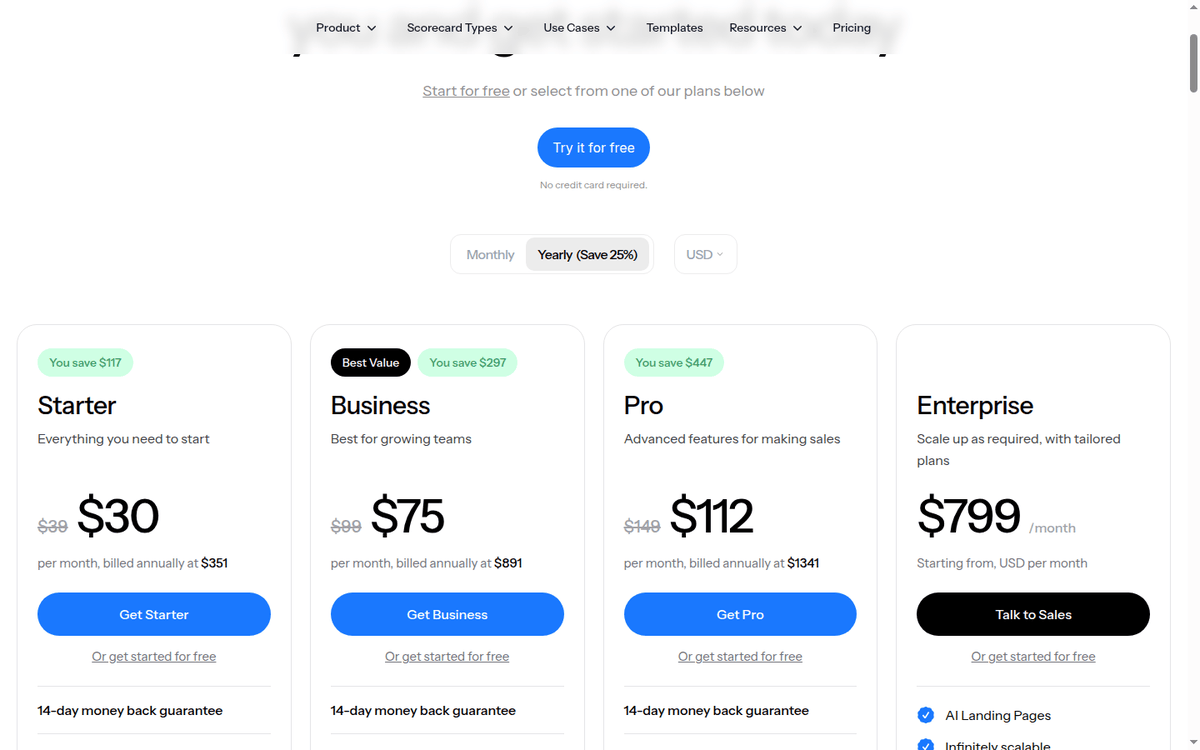
ScoreApp’s pricing is published in four tiers plus a one-time accelerator. The numbers are in US dollars and there is a free tier, a 14-day money-back guarantee on paid plans, and a separate Launch Accelerator bundle that sits outside the monthly plans.
Free. A working scorecard with up to 10 responses a month, 1 user, unlimited landing pages, dynamic result pages, AI Landing Pages, view-and-export of response data, and CRM connection. The free tier is enough to publish a campaign and prove the concept before committing to a paid plan.
Starter at $39/mo monthly, or $30/mo billed annually ($351/year, save $117). 3 live scorecards, 100 responses a month, 1 user.
Includes the AI Landing Pages, unlimited landing pages, dynamic result pages, view-and-export of response data, and CRM connection. Starter is the smallest paid step and is the right shape for a single quiz running on a single traffic source.
Business at $99/mo monthly, or $75/mo billed annually ($891/year, save $297). 10 live scorecards, 1,000 responses a month, 3 users.
Adds custom domain, abandon email (the triggered message to visitors who started but did not finish), advanced insights, custom CSS and scripts, Google Analytics and Facebook pixel, dynamic PDF report (a personalized PDF the lead can download), and audiences.
Business is the working tier for most coaches and consultants who are running one main quiz plus a few spin-off scorecards.
Pro at $149/mo monthly, or $112/mo billed annually: $1,341/year, save $447. 30 live scorecards, 3,000 responses a month, 5 users. Adds data enrichment (firmographic append to the lead), split testing, and everything Business has.
Enterprise starts at $799/mo, sales-led. Custom volume, custom integrations, infinitely scalable. This is the tier for agencies running many client quizzes and for brands that have already outgrown the response caps on Pro.
Launch Accelerator at £75 GBP one-time payment. This is a service bundle, not a SaaS subscription.
It includes 60 days of ScoreApp Business, a live launch session with Daniel Priestley, and four weeks of hands-on support from the ScoreApp team to build, launch, and promote a campaign. It is the closest thing ScoreApp sells to a “done with you” service.
The same page carries a registration window that closed at the end of September, with the program starting in early October and a $99 tier quoted in its FAQ, so treat the £75 figure as a time-boxed offer rather than a standing price.
All paid tiers include AI Landing Pages — a feature that auto-generates a landing page from a prompt — and all are covered by the 14-day money-back guarantee. Pricing was verified against the scoreapp.com/pricing page in September 2026 (ScoreApp pricing).
The response-cap trap, in plain math
The single number that decides whether ScoreApp is right for you is the monthly response limit. The published tiers top out at 3,000 responses a month on Pro, and Enterprise is quoted by sales rather than published as a number. The starting price on Pro is $149/mo monthly, or $112/mo annual.
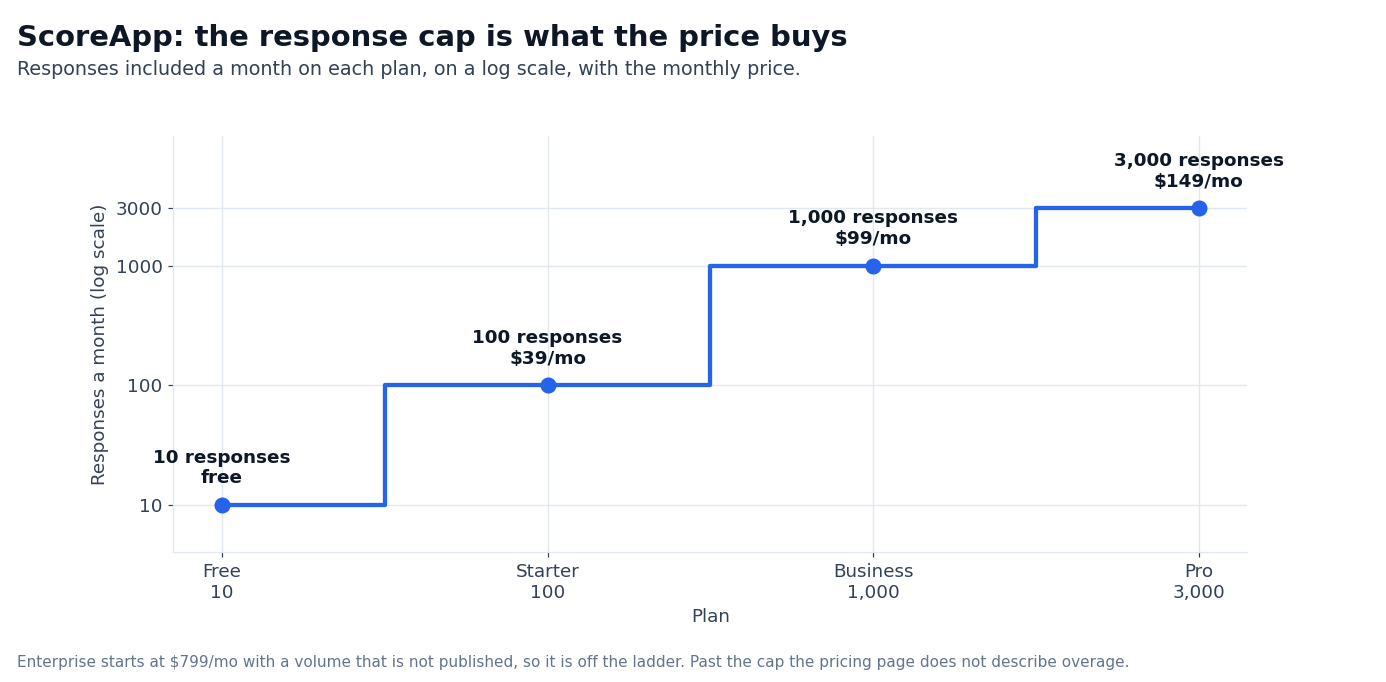
If you are running a quiz on a cold-traffic funnel and converting 30% of click-throughs, 3,000 responses means roughly 10,000 visits a month on a single quiz.
That is a real number for a mid-sized B2B audience or a course creator with a working list, but it is small for a media-buyer running paid social at scale.
The honest read on the response cap is that it is generous for coaches and course creators. It is tight for agencies running quizzes for many clients. And it is very tight for any campaign where paid traffic is the main source.
If your quiz is going to see 50,000+ visits a month, you need the Enterprise tier ($799/mo starting) or you need a different tool.
ScoreApp does not publish what “Enterprise” actually costs at scale — pricing is a sales conversation past Pro (ScoreApp pricing page).
The scorecard editor: what you actually build
A ScoreApp scorecard is a multi-step interactive quiz. The editor is a drag-and-drop sequence builder. Each step is one of several types. A question: multiple choice, single choice, slider or short text.
An outcome reveal (the personalized result the lead sees at the end). A redirect, to a calendar booking, a sales page or a thank-you. Or a content block.
The thing that separates a ScoreApp campaign from a Typeform is the outcome logic. Each answer is a point value, and the points accumulate into a score or a category.
At the end of the quiz the lead sees their result, and you can branch the path based on the score. A hot lead goes to a calendar link. A lukewarm lead goes to a long-form nurture. A cold lead gets a low-friction next step.
This is the mechanic that does the work — without it, the quiz is just a fancier form.
The platform also includes AI Landing Pages, which generate a landing page from a natural-language prompt. The output is a starting point — you still edit, you still test, and the design is constrained to ScoreApp’s templates.
For a coach who wants a working page in 30 minutes instead of a designer in 5 days, that is a real time saving.
The dynamic PDF report is the highest-leverage feature for a coach or consultant. When the lead finishes the quiz, ScoreApp can generate a personalized PDF — their score, a written interpretation and a recommended next step — and email it to them.
That PDF becomes the entry point for a sales conversation: the lead now has a tangible artifact to bring to a call, and the coach has a structured diagnosis to anchor the call with.
The CRM and email automation story
ScoreApp is not a CRM and it is not an email service provider. The product is a quiz funnel that hands leads off to your CRM through native integrations, Zapier, or the public API.
The score plus the answer-by-answer breakdown is sent as custom fields on the contact, which means your sales team can see the lead’s actual answers in the CRM, not just a number.
The abandon email is the second-leverage automation. When a visitor starts the quiz but does not finish, ScoreApp sends a triggered email reminding them to come back. The published mechanic on the Business tier and above.
Abandoned starts are a real share of paid-traffic leads, and this single email is the recovery path for them; how large that share is depends on your quiz length and your traffic, which only a live campaign can tell you.
The honest read is that ScoreApp is a top-of-funnel and qualification tool. It does the qualification and the segmentation, then it hands off to a tool whose job is the nurture and the close.
If you are running a $1M-per-year coaching business, you already have the CRM and the email stack; ScoreApp plugs in.
If you are starting from zero, the all-in-one pitches from systeme.io or ConvertKit might be a better starting point (systeme.io pricing).
ScoreApp vs the alternatives, head to head
The honest comparison depends on what you are trying to do.
Against Typeform. Typeform is the more polished form-builder and the better tool for surveys, contact forms, and short questionnaires.
ScoreApp wins on the score-and-segment mechanic — Typeform can compute a score but it does not treat the outcome as a first-class object the way ScoreApp does. Typeform is also more expensive at scale. For a 2-question form, Typeform is the right shape.
For a 15-question scorecard with branching and a personalized outcome, ScoreApp is the right shape.
Against Riddle. Riddle is the closer direct competitor — quiz builder, lead-gen form, and outcome logic. Riddle is cheaper at the entry tier and has more quiz-style templates.
ScoreApp wins on the dynamic PDF report, the abandon email, and the depth of the CRM integrations. Riddle wins on price at low volume. For a marketing team running multiple quizzes for content marketing, Riddle is a reasonable alternative.
For a coach or consultant who needs the personalized outcome artifact to anchor a sales conversation, ScoreApp is the closer fit.
Against Outgrow, involve.me, and the long tail. Outgrow and involve.me are calculator-style and assessment-style funnel builders, more common in B2B SaaS and finance. ScoreApp is the more coach-and-consultant-tuned brand.
If your quiz is a mortgage calculator or a savings estimator, those tools are competitive. If your quiz is a personality or readiness assessment, ScoreApp is the closer fit.
Against building it in your CRM. Most modern CRMs — HubSpot, ActiveCampaign, ConvertKit — ship with form and quiz builders.
The honest read is that a CRM-native quiz is good enough for a 3-question form and a simple email capture, and bad at the branching-and-outcome mechanic.
If you are doing anything beyond a 5-question form with a single email follow-up, a dedicated quiz tool earns its place.
ScoreApp pricing at a glance
| Tier | Monthly | Annual | Scorecards | Responses/mo | Users | Best for |
|---|---|---|---|---|---|---|
| Free | $0 | $0 | 1 | 10 | 1 | Validation, single quiz on cold traffic |
| Starter | $39/mo | $30/mo ($351/yr) | 3 | 100 | 1 | Single working campaign |
| Business | $99/mo | $75/mo ($891/yr) | 10 | 1,000 | 3 | Coach or consultant running 1–3 quizzes |
| Pro | $149/mo | $112/mo ($1,341/yr) | 30 | 3,000 | 5 | Agency running multiple client campaigns |
| Enterprise | $799+/mo | custom | custom | custom | custom | High-volume or paid-traffic scale |
| Launch Accelerator | £75 one-time, window closed | — | — | — | — | 60 days Business + Priestley launch session |
Numbers verified against scoreapp.com/pricing in September 2026. All paid tiers include AI Landing Pages, custom domain (Business+), abandon email (Business+), dynamic PDF report (Business+), split testing (Pro), data enrichment (Pro).
When ScoreApp is the wrong pick
Three workloads where ScoreApp is not the right shape.
The first is high-volume paid social.
If your media-buying strategy depends on a quiz opt-in at the top of a paid funnel and you are spending more than $20k/mo on traffic, the response cap on Pro is going to bite and the Enterprise tier is going to be expensive.
Tools like Outgrow, involve.me, or a custom build on Webflow plus your CRM will handle the volume more cheaply.
The second is multi-language or region-specific campaigns. The published material does not describe multi-language scorecards, so a campaign in ten languages means ten scorecards and the operational overhead that comes with them.
If you are running a quiz in 10 languages for a global audience, the operational overhead is high.
The third is anything where the lead’s answers need to drive a downstream automation beyond “send email.” If your quiz needs to update a CRM deal stage, create a Salesforce opportunity, or trigger a custom workflow in your back office, the integration depth on ScoreApp is the limit.
Zapier and the public API can do most of it. A custom build in your CRM is more flexible.
What we could not verify
Three classes of figure in this review depend on real campaign data that we could not benchmark without running paid traffic on a live scorecard. They are flagged as unverified in this review.
The actual completion rate on a 15-question scorecard is workload-dependent: short quizzes finish at a much higher rate than long ones, and we have not measured where a ScoreApp scorecard lands on that curve.
The post-quiz show-up rate on a booked call is the metric that decides whether a quiz funnel is profitable. The published case study on Akash Vaghela’s RNT Fitness claims 100 leads a month, every month.
We have not independently measured show-up rates on a real campaign (ScoreApp customer stories).
The deliverability of the abandoned-cart email is the third — ScoreApp sends it from your domain, and your domain’s sender reputation determines whether it lands in inbox or spam. This is unverified on every install.
FAQ
How much does ScoreApp cost?
ScoreApp pricing starts free, then $39/mo for Starter, $99/mo for Business, and $149/mo for Pro billed monthly. Annual billing saves 20–25%: $30/mo Starter, $75/mo Business and $112/mo Pro. Enterprise starts at $799/mo, sales-led.
Does ScoreApp have a free plan?
Yes. The free plan supports one scorecard, up to 10 responses a month, unlimited landing pages, dynamic result pages, AI Landing Pages, and CRM connection. No credit card is required to start.
What is the response limit on ScoreApp?
Response limits are: Free 10/mo, Starter 100/mo, Business 1,000/mo, Pro 3,000/mo, Enterprise custom.
Is ScoreApp the same as Typeform?
No. Typeform is a form-builder with a polished design surface. ScoreApp is a quiz-funnel and scorecard-funnel builder with branching logic, outcome scoring, and CRM handoff as first-class features. They overlap on the simple-form use case but diverge on the qualification-funnel use case.
Does ScoreApp integrate with HubSpot?
Yes. CRM connectivity is listed on every tier including Free — the pricing page sells it as “Connect your CRM” rather than naming individual services — and Zapier plus the public API cover everything outside that list.
Can I cancel any time?
Yes. ScoreApp is month-to-month or annual, no long-term contract. The 14-day money-back guarantee applies to all paid plans.
Who founded ScoreApp?
ScoreApp was founded by Steven Oddy and Daniel Priestley. Daniel Priestley is the author of Oversubscribed and the public face of the brand. The company is based in the UK and serves customers in 187 countries.
ScoreApp vs Riddle — which is better for a coach running a quiz funnel?
ScoreApp. Riddle is cheaper at the entry tier and has more quiz-style templates. ScoreApp has the deeper CRM integrations, the dynamic PDF report, the abandon email, and the outcome-as-first-class-object mechanic that a coaching funnel depends on.
Does ScoreApp charge per response after the cap?
ScoreApp sells flat monthly plans with a published response cap rather than a per-response meter. The pricing page does not describe overage charges, so the practical choice past the cap is to upgrade a tier.
Can ScoreApp replace my email service provider?
No. ScoreApp is a quiz-funnel builder, not an ESP. It sends the abandon email and the result email, but the nurture sequence, broadcast, and list management belong in your ESP — ConvertKit, ActiveCampaign, Mailchimp and the rest.
How long does it take to publish a ScoreApp campaign?
For a coach with a working landing page and a clear question set, a single scorecard can be live in 2–4 hours. The AI-generated landing page counts toward that window. A multi-quiz campaign with custom logic and dynamic PDF takes 1–3 days.
How we put this together: the four plan prices, the annual rates, the saving badges, the response caps, the feature lists and the Launch Accelerator terms come from scoreapp.com/pricing and scoreapp.com/launch-accelerator, quoted as displayed.
We have not run a live scorecard or measured a completion rate on a real campaign of our own, so the traffic-side numbers stay flagged where they appear.
Figures that depend on a real workload, a real target or a real integration are flagged where they appear in the text rather than being estimated.
Disclosure: this article contains affiliate links. If you buy through them we may earn a commission at no extra cost to you. Commission never changes our scoring or the order of a ranking.