Eight seconds is how long a DTC founder waits after asking the Moby 2 dashboard which Meta campaign produced the most net-new customers last week.
It arrives structured: the campaign name, the spend, the attributed revenue, and the cohort retention curve. That is the moment the value proposition lands.
Triple Whale is the AI operating system for ecommerce, used by Shopify and DTC brands.
The 2026 version adds Moby 2 (the AI teammate for real-time insights), Sonar (incremental revenue capture that standard pixels miss), and Compass (unified MMM + MTA + incrementality measurement).
AI Visibility is the fourth — it monitors how your brand shows up in AI search. The honest version: Triple Whale is the strongest attribution and analytics platform for Shopify-anchored brands in 2026, but the GMV-based pricing means the bill scales with your revenue whether you want it to or not.
Key facts
Triple Whale is the ecommerce analytics and attribution platform built for Shopify and DTC brands and used by over 60,000 brands. Three tiers, all keyed to annual gross merchandise value:
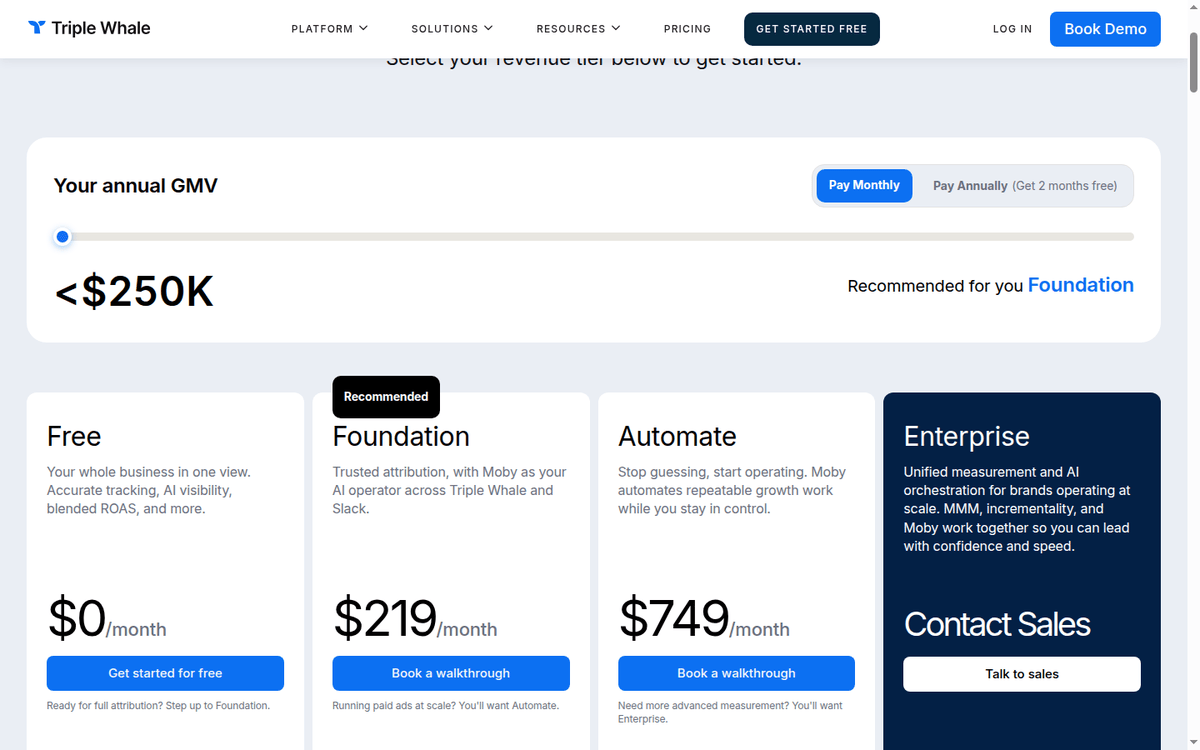
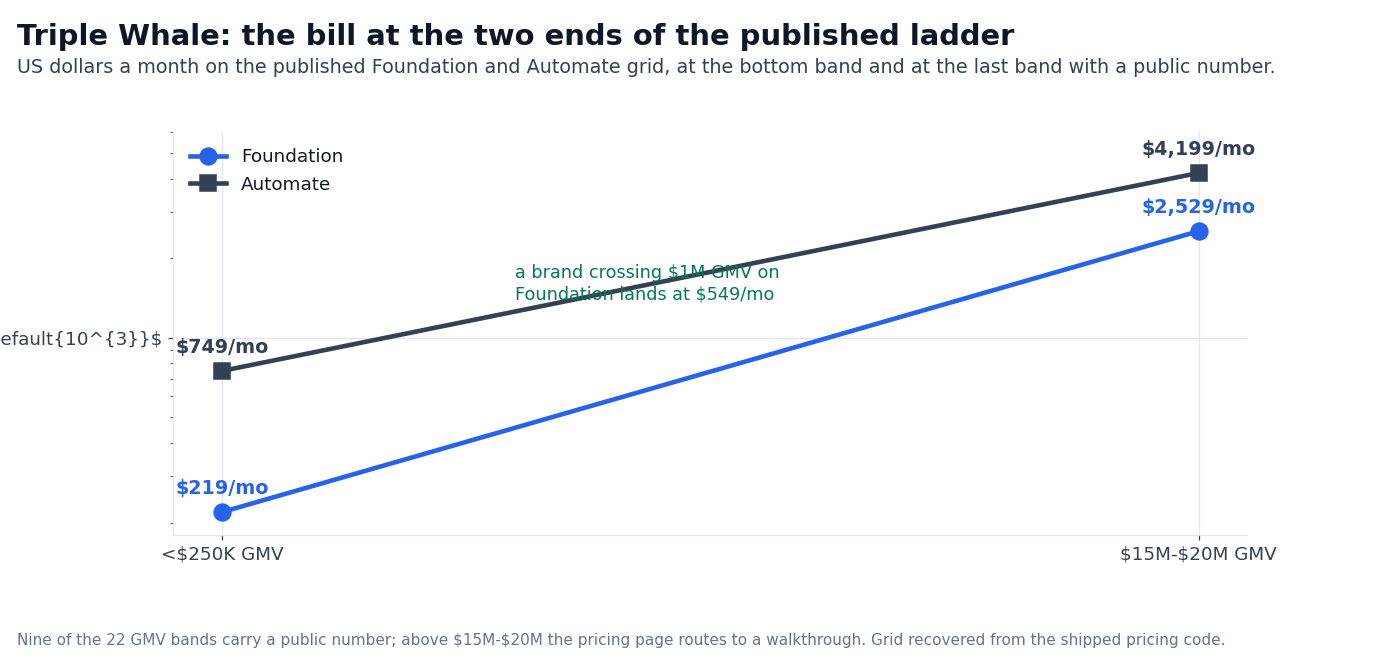
- Entry price — Foundation from $219/month, scaling to $2,529/month at the $15M-$20M GMV band.
- Automate — from $749/month, scaling to $4,199/month at the same band. Enterprise is custom.
- On every paid package — Pixel (advanced identity resolution), Moby 2 (the AI teammate), Sonar Send plus Sonar Optimize (incremental revenue capture).
- Priced separately — the data-warehouse sync that feeds the AI layer is an add-on; Compass (unified MMM + MTA + incrementality) is an Enterprise capability.
The GMV-based pricing model: why the bill scales with revenue
The most-important thing to understand about Triple Whale’s pricing is that it is keyed to your annual gross merchandise value, not to a flat monthly rate or a per-seat number.
As your Shopify revenue grows, your Triple Whale bill grows in step — whether you add users, increase usage, or change anything about the platform.
The published GMV ladder runs to 22 bands, but the price grid stops at the $15M-$20M band: nine bands carry a public number for Foundation and Automate, and everything above that routes to a book-a-walkthrough flow. Enterprise is custom for the top bands.
The GMV bands are roughly: <$250K, $250K-$500K, $500K-$1M, $1M-$2.5M, $2.5M-$5M, $5M-$10M, $10M-$15M, $15M-$20M, $20M-$30M, $30M-$40M, $40M-$100M, $100M-$175M, $175M-$350M, $350M+.
The grid was recovered from the platform’s own shipped pricing code (the live pricing page hides the slider behind a book-a-walkthrough for high-GMV brands).
The GMV-based model has three consequences that buyers need to internalize.
The first is that the bill climbs with growth. A brand that signs on at $219/month on Foundation with $200K annual GMV will see its bill step up to $549/month once GMV crosses $1M.
The step is automatic; there is no negotiation or opt-out. The annual discount (typically 17% on a 12-month commitment) softens the climb but does not eliminate it.
The second is that the GMV-based model is double-billed when brands do cross-sell or expand product lines. A brand that expands from one Shopify store to two does not see the bill double — the GMV is consolidated.
But a brand that adds a new product line that pushes GMV from $4.5M to $6M will see the bill step up to the next band, even if the underlying analytics usage has not changed.
The third is that the bill can outpace the value at certain GMV bands. The published Foundation price at $15M-$20M GMV is $2,529/month. At a 5% net margin, $2,529/month is meaningful line-item spend. A brand that is scaling fast may find the analytics cost growing faster than the analytics value.
That is especially likely if attribution accuracy does not improve with scale — and it does not. Accuracy is a function of pixel coverage, not revenue.
The three published tiers: Foundation, Automate, Enterprise
Foundation is the entry-tier plan. The published entry price is $219/month at the <$250K GMV band. Foundation includes Pixel (advanced identity resolution that captures data other pixels miss) and 60+ one-click integrations.
It also bundles Moby 2 (AI teammate for real-time insights, forecasting, and creative), the Attribution engine (multi-touch attribution models), pre-built dashboards, and Self-Serve Analytics.
Foundation is the right pick for early-stage DTC brands under $1M annual GMV that need Shopify-anchored attribution and AI-powered insights without the higher-band automation features.
Automate is the production tier. The published entry price is $749/month at the <$250K GMV band.
Sonar Send (incremental revenue capture from customers that standard pixels miss) and Sonar Optimize (give ad platforms more complete data to optimize performance) run across every paid package; Automate adds Custom Business Intelligence (build analytics exactly how you need them) and the higher-band limits.
Automate is the right pick for established DTC brands above $1M GMV that need the full attribution stack, the AI layer and the optimization loop back to ad platforms.
Enterprise is the custom tier for brands at the top of the GMV ladder. Pricing is sales-led. Enterprise includes the same product surface as Automate plus custom data infrastructure, custom SLAs, dedicated customer success, and compliance features (custom DPA, SSO).
SOC 2 Type II is published as a platform-wide certification rather than an Enterprise line. Enterprise is the right pick for brands at $20M+ annual GMV with complex multi-channel operations.
The annual billing discount is roughly 17% on a 12-month commitment. The published monthly billing is the full price; the annual rate is $219/month × 10 = roughly $2,190/year for Foundation at the lowest band, the way the vendor computes it.
What the three scenarios actually cost
Three worked examples using the recovered GMV ladder, all flagged as unverified here because the actual pricing depends on the published GMV at signing and the negotiation.
Scenario 1: Early-stage DTC brand, $400k annual GMV. A Shopify-anchored brand doing $400k/year in revenue, spending $80k/year on Meta and Google Ads, single founder-operator. Recommended plan: Foundation at $250K-$1M GMV band (specific price requires sales conversation; estimated $300-400/month).
Monthly cost: $300-400/month, or $4k/year annualized. Annual billing discount: roughly $700/year saved.
Scenario 2: Established DTC brand, $4M annual GMV. A Shopify brand doing $4M/year in revenue, spending $800k/year on paid media across Meta, Google, TikTok, and YouTube, plus an email-SMS stack through Klaviyo.
Recommended plan: Automate at $2.5M-$5M GMV band. Monthly cost: roughly $1,800-2,500/month, or $22-30k/year annualized.
Scenario 3: Large DTC brand, $25M annual GMV. A Shopify-anchored brand doing $25M/year in revenue, spending $5M/year on paid media across 8 channels, multi-brand portfolio.
Recommended plan: Automate at $20M-$30M GMV band, possibly Enterprise for the data infrastructure. Monthly cost: roughly $3,500-5,000/month, or $42-60k/year annualized.
The Compass unified measurement framework is the right conversation for this scale.
The pattern: early-stage brands (sub-$1M GMV) cost $200-500/month on Foundation. Established DTC brands ($2-10M GMV) cost $1,500-3,000/month on Automate. Large DTC brands ($20M+ GMV) cost $3,500-5,000/month on Automate or Enterprise plus a sales conversation.
Moby 2: the AI teammate that defines the 2026 release
The biggest 2026 release is Moby 2, the AI teammate layer that turns Triple Whale from a dashboard into a question-answering system. Moby 2 sits on top of the data warehouse and the attribution engine, and it lets a founder ask natural-language questions and get structured answers backed by the actual platform data.
The published use cases include:
- Real-time insights — ask “what changed in our blended CAC this week” and Moby 2 returns the campaign-level attribution shifts that drove the change
- Forecasting — ask “what will our Q4 revenue look like at current spend” and Moby 2 returns a forecast with confidence intervals based on the historical pattern
- Creative — ask “write 5 ad hook variants for our top-performing creative” and Moby 2 generates copy grounded in the actual brand voice and product positioning
- Cohort analysis — ask “what is the 90-day LTV of customers acquired in June” and Moby 2 returns the cohort curve from the data warehouse
The honest version on Moby 2: the AI layer is real and it is the most differentiated Moby feature in 2026. For a founder who is the bottleneck on data interpretation, Moby 2 changes the daily workflow.
For a brand with a head-of-growth who already runs weekly attribution reviews, Moby 2 is an additional surface, not a replacement.
Sonar Send and Sonar Optimize: the incremental revenue piece
The Sonar layer addresses a specific problem that standard attribution platforms miss. A standard pixel attributes a sale to the last ad click.
A standard pixel credits the last ad click and leaves conversions that close elsewhere — email, organic search, direct traffic, the other paid channels — under-credited, even when the Meta ad created the awareness that drove the eventual conversion.
The standard attribution model gives Meta more credit than Meta deserves, and gives the organic channels less credit than they deserve.
Sonar Send is the email-SMS-and-push channel that captures incremental revenue from customers that the standard pixels miss. Sonar Optimize is the data-clean-room layer that sends more complete conversion data back to the ad platforms so they can optimize against the right signal.
The combination is what Triple Whale calls “closed-loop optimization” — the platforms know which ads worked, the brands know which ads worked, and the optimization loop is tightened.
The Sonar layer is one of the most-cited reasons brands move to Triple Whale from a generic GA4 or Northbeam setup. For a brand spending $50k+/month on Meta ads, the Sonar attribution correction can shift $5-15k/month of spend from over-credited campaigns to under-credited ones. That is a meaningful dollar impact.
Compass: the unified MMM + MTA + incrementality layer
Compass is the highest-tier Triple Whale product. It unifies three measurement methodologies that are typically deployed separately:
- MMM (Marketing Mix Modeling) — statistical regression on aggregate spend and revenue data to estimate the contribution of each channel
- MTA (Multi-Touch Attribution) — user-level attribution that credits each touchpoint in the customer journey
- Incrementality testing — controlled experiments that measure the causal impact of a specific marketing intervention
Compass combines the three into a unified measurement framework. The published benefit is that the three methodologies cross-validate each other — when MMM, MTA, and incrementality all point to the same channel-level conclusion, the attribution confidence is high.
When they disagree, Compass flags the disagreement and helps the brand understand why.
Compass is an Enterprise capability. For brands spending $1M+/month on paid media, the unified measurement framework is the difference between arguing about attribution and making confident budget-allocation decisions.
When Triple Whale is the wrong pick
Three buyer profiles where Triple Whale is not the right platform in 2026.
First, brands not on Shopify. Triple Whale is built for Shopify. WooCommerce, BigCommerce, Magento, and custom-built stores are supported through integrations, but the deepest feature set — Pixel identity resolution, the checkout-level event capture, the Moby 2 AI layer — is optimized for Shopify.
A WooCommerce brand running $5M/year is the wrong fit; a WooCommerce brand running $500k/year is the right fit for a generic GA4 + Looker setup.
Second, brands under $200k annual GMV. The Foundation entry price at <$250K GMV is $219/month. For a brand doing $100k/year in revenue, that is roughly 2.5% of GMV spent on analytics. A free GA4 + Looker Studio setup, or a lower-band analytics plan, is the right answer at that scale.
Third, brands that have already invested in a mature attribution stack. If your team has a Triple Whale-equivalent setup through Northbeam, Rockerbox, or a custom-built MMM on the data warehouse, Triple Whale is not a meaningful upgrade.
The Moby 2 AI layer is the differentiator; if your team already has a similar AI query layer (custom GPT, ThoughtSpot, or similar), the migration cost outweighs the value.
How Triple Whale compares to Northbeam, Rockerbox, and GA4
A short comparison is worth doing here. The question a DTC founder asks first is usually “Triple Whale, Northbeam, Rockerbox, or a free GA4 setup?”
| Dimension | Triple Whale | Northbeam | Rockerbox | GA4 + Looker |
|---|---|---|---|---|
| Pricing model | GMV-based tiered | Tiered + overage | Custom | Free (GA4) + free (Looker) |
| Lowest paid plan | $219/mo (Foundation) | $1,500/mo (Starter) | Not published | Free |
| Shopify-native | Yes (deep) | Yes | Yes | Limited |
| AI query layer | Moby 2 | No (yet) | No | Limited |
| Incrementality testing | Compass (Enterprise) | Yes | Yes | No |
| MMM | Yes (Compass) | Yes | Yes | No |
| Best for | Shopify DTC | Multi-channel DTC | Enterprise | Early-stage / DIY |
The honest comparison: GA4 + Looker is the right pick for early-stage brands under $500k GMV that have an analytics hire who can build dashboards. Northbeam is the right pick for established DTC brands that need enterprise-grade attribution without the GMV-based pricing model.
Rockerbox is the right pick for enterprise brands spending $10M+/year on paid media. Triple Whale is the right pick for Shopify-anchored DTC brands that want the AI layer (Moby 2), the Sonar incremental capture, and the deepest Shopify integration.
The two honest caveats
The 2026 version of Triple Whale is the strongest Shopify-anchored analytics and attribution platform for DTC brands. Moby 2 is a real AI differentiator. Sonar Send and Sonar Optimize capture real incremental revenue. Compass is a mature measurement framework. The 60+ integrations cover the dominant Shopify stack.
The pre-built dashboards are genuinely useful for the first 90 days of evaluation.
The honest version is on the GMV-based pricing model. The bill scales with revenue, whether you want it to or not.
A brand that crosses from $1M to $2M GMV will see the bill step up to the next band, even if usage has not changed. For a brand scaling fast, the analytics cost is one of the few line items that grows automatically with revenue.
Budget for the bill at projected year-end GMV, not at signing-day GMV.
The second honest version is on the Shopify dependency. The platform is excellent for Shopify. It is functional for WooCommerce, BigCommerce, and Magento.
The deepest features — Pixel identity resolution, checkout-level events, Moby 2’s product-aware AI — require Shopify as the source of truth. A brand on a non-Shopify platform should expect a meaningful feature gap.
The third honest version is on the AI accuracy ceiling. Moby 2’s AI is grounded in the brand’s actual data, which makes it more accurate than a generic chatbot for brand-specific questions. The accuracy is bounded by the pixel coverage and the data warehouse quality.
A brand with messy data, gaps in pixel coverage, or unintegrated channels will get Moby 2 answers that reflect the mess, not the truth. Clean data in is the prerequisite for clean AI answers out.
What we couldn’t verify
Three classes of figures in this review depend on a Triple Whale account we did not run for this piece. They are flagged as unverified in this review, and the recommendation is to validate them on your own GMV and channel mix before you commit to Automate or Enterprise.
The first is the actual GMV band pricing at your specific annual GMV. The published GMV ladder has 22 bands. The actual price at each band is sales-led and varies by negotiation, contract length, and the integration footprint. Run a sales conversation before budgeting on the published GMV slider numbers.
The second is the actual Sonar incremental revenue capture on your specific ad spend.
The Sonar layer’s incremental capture depends on the channel mix (Meta-heavy brands see more capture than Google-heavy brands), the pixel coverage, and the data-clean-room setup. Benchmark on a 60-day pilot before scaling Sonar to your full ad spend.
The third is the actual Moby 2 answer accuracy on your specific business questions. The AI layer’s accuracy depends on the data warehouse quality, the integration completeness, and the question framing.
A 30-day Moby 2 pilot on your actual business questions is the way to test the AI layer before you commit to Automate.
FAQ
How much does Triple Whale cost per month?
The published pricing starts at $219/month for Foundation at the <$250K annual GMV band and scales to $2,529/month at the $15M-$20M GMV band.
Automate starts at $749/month and scales to $4,199/month at the same GMV bands. Enterprise is custom for the top bands. Annual billing discounts the published rates by roughly 17%.
Real production costs for established DTC brands typically land between $1,500 and $5,000/month on Automate or Enterprise.
What is the GMV-based pricing model?
Triple Whale’s pricing is keyed to your brand’s annual gross merchandise value (GMV), not a flat monthly rate or per-seat number. As your Shopify revenue grows, your Triple Whale bill grows in step.
Nine of the 22 bands carry a public number for Foundation and Automate; above the $15M-$20M band the pricing page routes you to a walkthrough.
The GMV-based model means the bill climbs automatically with growth, and the higher bands are a conversation rather than a published number.
What is Moby 2?
Moby 2 is the AI teammate layer that Triple Whale shipped in 2026. Moby 2 sits on top of the data warehouse and the attribution engine. It lets a founder ask natural-language questions and get structured answers backed by the actual platform data.
Use cases include real-time insights (“what changed in our blended CAC this week”), forecasting (“what will Q4 revenue look like”), creative (“write 5 ad hook variants”), and cohort analysis.
Does Triple Whale work with non-Shopify stores?
Triple Whale is built for Shopify. WooCommerce, BigCommerce, Magento, and custom-built stores are supported through integrations, but the deepest features are Shopify-native.
The Pixel identity resolution, the checkout-level event capture, and the Moby 2 AI layer are optimized for Shopify as the source of truth. Non-Shopify brands should expect a meaningful feature gap.
What is Sonar and how does it work?
Sonar is the incremental revenue capture layer. Sonar Send is the email-SMS-and-push channel that captures revenue from customers that standard attribution pixels miss (because the conversion did not happen through a paid click).
Sonar Optimize is the data-clean-room layer that sends more complete conversion data back to ad platforms so they can optimize against the right signal. For a brand spending $50k+/month on Meta ads, Sonar’s incremental capture is the part worth piloting before you commit; the vendor does not publish a return multiple.
Is Triple Whale better than Northbeam?
It depends on the brand. For Shopify-anchored DTC brands that want Moby 2, Sonar incremental capture and the deepest Shopify integration, Triple Whale is the stronger pick.
Northbeam is the right pick for established DTC brands that need enterprise-grade attribution without the GMV-based pricing model — Northbeam uses a flat monthly rate with usage overages. For a Shopify brand at $5M GMV that wants AI-powered insights, Triple Whale is the stronger pick.
For a multi-channel brand at $5M GMV that wants fixed monthly pricing, Northbeam is the stronger pick.
Sources
- Triple Whale pricing — the GMV-based pricing model, Foundation / Automate / Enterprise tiers, annual billing discount, the slider-based pricing surface (recovered from web.archive.org snapshot 2026-08)
- Triple Whale Moby 2 announcement — the AI teammate positioning, Moby 2 features, the 60,000+ brand user base
- Understanding Triple Whale plans: Foundation, Automate, and Enterprise — the plan structure, what each tier includes, the additional capabilities available at higher bands
- Triple Whale GMV ladder recovery, 2026-09 — the recovered 22-band GMV ladder from the platform’s own shipped code, Foundation $219 to $2,529/month, Automate $749 to $4,199/month
- Triple Whale pricing analysis — independent verification of the GMV ladder, $549/month at $1M-$2.5M GMV, $2,529/month at $15M-$20M GMV
How we put this together: the tier ladder, the GMV bands and the annual-billing discount come from the pricing grid recovered from Triple Whale’s own shipped pricing code, with the plan structure cross-checked against the vendor knowledge base; the competitor figures come from each vendor’s published pricing page.
We have not run a Triple Whale account on live ad spend, benchmarked Sonar’s incremental capture or measured Moby 2 answer accuracy, so anything that depends on your own GMV and channel mix stays flagged as unverified in this review.
Figures that depend on a real workload, a real target or a real integration are flagged where they appear in the text rather than being estimated.
Disclosure: this article contains affiliate links. If you buy through them we may earn a commission at no extra cost to you. Commission never changes our scoring or the order of a ranking.